Helena Stiasny
The Abduction of Europa
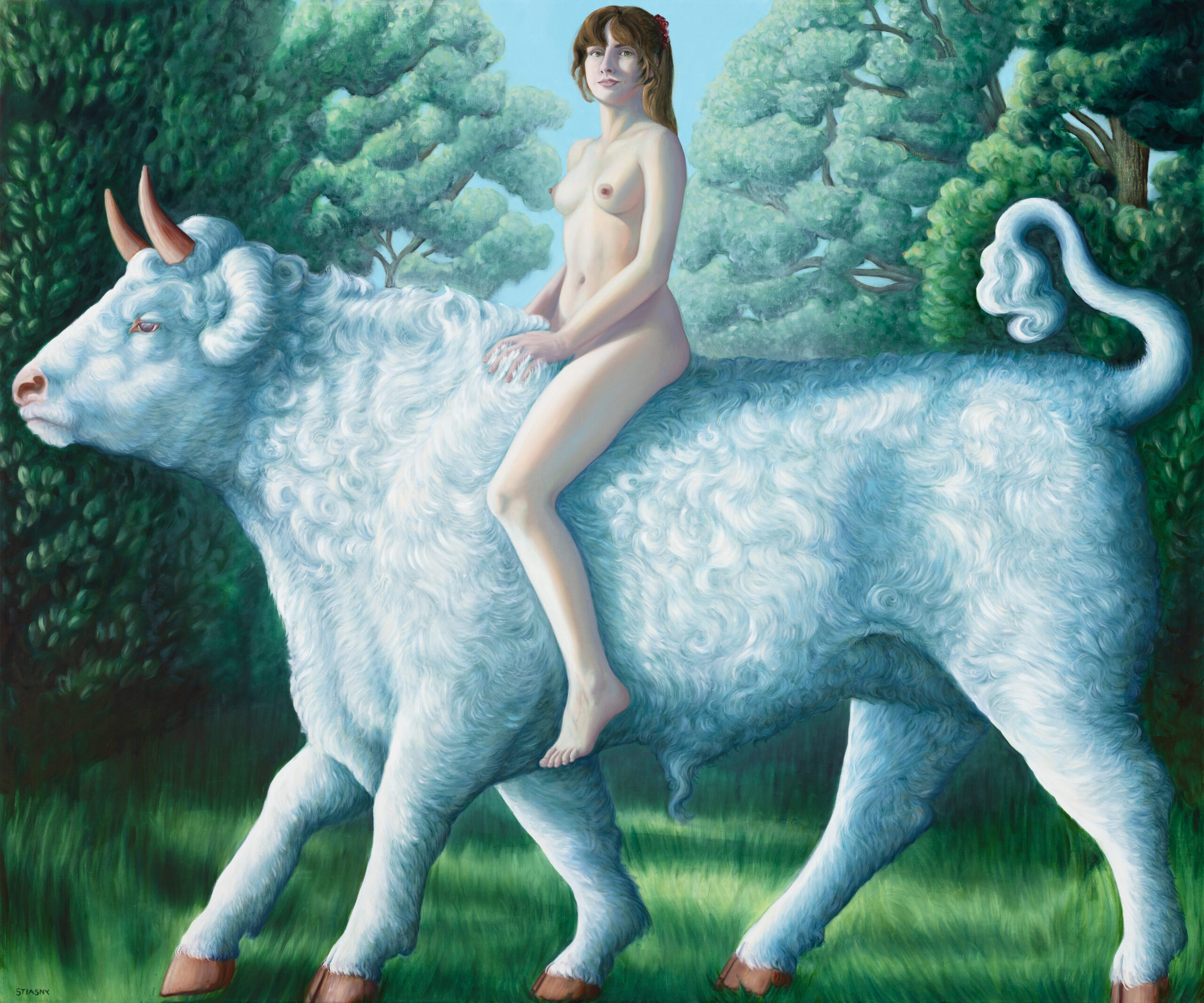
Helena Stiasny, The Abduction of Europa, oil on canvas, 200 x 240 cm,
phot. courtesy of the artist
Helena Stiasny reverses this narrative. Her Europa does not appear to have been abducted. Bearing the artist’s own face, the protagonist sits comfortably and confidently on the bull’s back. She gazes directly at the viewer, unselfconsciously, her hand resting on the animal as if she were the one steering their journey.
Stiasny’s bull embodies something more dangerous than Zeus himself. White, as in Greek mythology, and five-legged, like the Assyrian Lamassu, it does not represent any single force. It is simultaneously an ancient god, a vision of success, a grand idea, or a fleeting desire – anything that seduces us with a promise, because we want to believe, to be enchanted, and to be swept away.
Stiasny has long been fascinated by the tension inherent in representations of women in art. By revisiting one of the most enduring myths in European painting and inserting her self-portrait into it, she reverses its traditional narrative. Here, Europa does not need to resist seduction to retain her agency – she allows herself to be enchanted without relinquishing control. The bull remains just a symbol and yet so much more. Where it takes the protagonist depends on how firmly she holds its mane.
More: