Mouhcine Rahaoui
Coal: Medium and Testimony
Personal and Collective History
The work of Mouhcine Rahaoui is deeply rooted in both his personal experiences and the history of his hometown, Jerada, situated in the oriental region of Morocco. The artist belongs to a group of creators whose practices are directly shaped by their biographies – his father worked in the mines and growing up in a community centred around the extractive industry has significantly shaped his artistic sensitivity.
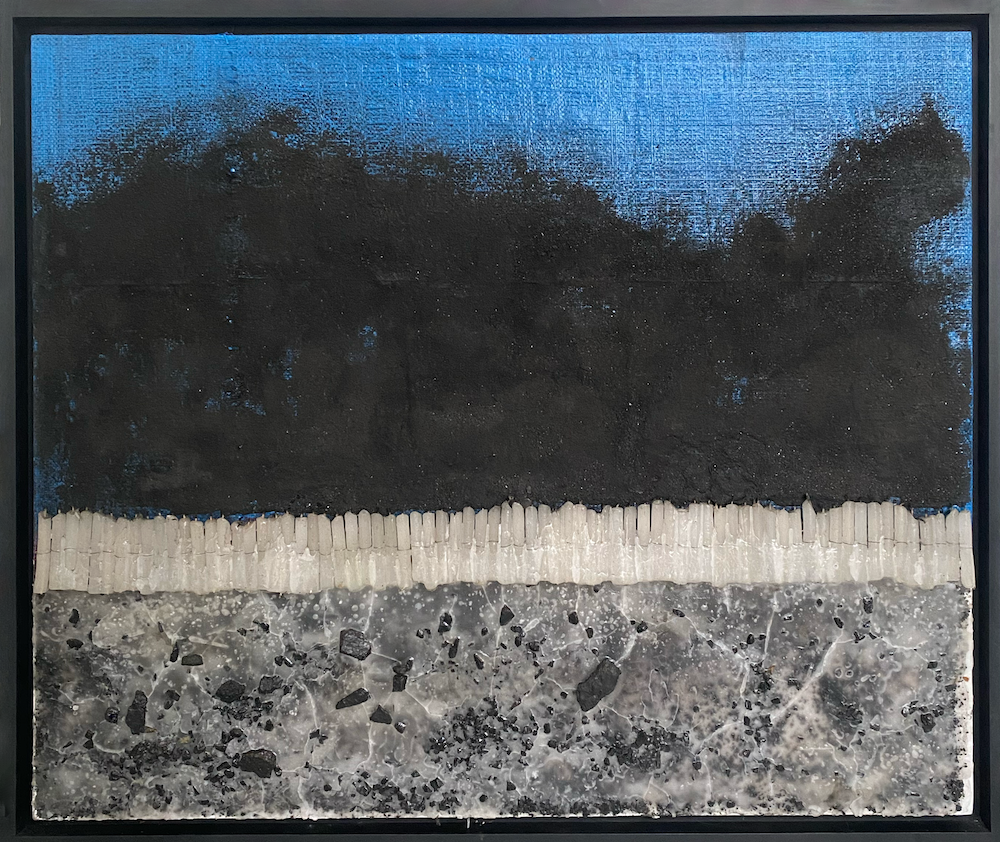
Mouhcine Rahaoui, Mineur, 2023,
plastic, charcoal and wax on canvas, 100 x 120 cm,
photo courtesy of the Afikaris Gallery
Jerada flourished in the 1930s as one of Morocco’s most pivotal coal mining areas. However, after the mines were closed in the early 21st century, a large portion of the population left the city. Those who remained, confronted with a lack of alternative employment, continued to mine illegally, exposing themselves to constant danger. Even after the official shutdown, the mines remained the primary source of livelihood for many families, despite the obvious risks and frequent fatal accidents.
Rahaoui does not document this reality in a literal sense; instead, he transforms it through art. In his work, the mine becomes less a workplace and more a metaphor for a vicious cycle, one that continues to ensnare generation after generation of Jerada’s inhabitants.
Matter as a Bearer of Meaning
Mineur is part of a series of works in which Rahaoui employs materials such as coal, wax, candles, and fragments of worn plastic bags that were once used to transport coal. In this context, each element serves both a formal and symbolic function.
Coal – present in his work not only as a pigment but also as a sculptural material—serves as both subject and medium. It’s color and texture create a distinct visual language. Equally significant is its dual nature: a resource essential to the modern economy, yet toxic and for the local community, the sole means of survival.
Candles are a recurring motif, treated by the artist as symbols of solidarity and collective experience. Aligned in a row, they evoke the image of miners descending into the shaft at dawn. However, their warm light is completely obscured by the darkness of coal.
Wax, which serves as a binder in Rahaoui’s work, symbolizes corporeality. The artist characterizes it as a substance reminiscent of drops of sweat and tears, embodying a slow disintegration – life eroded by the harsh conditions in which the people of Jerada navigate their daily existence.
The composition of Mineur unfolds into an abstract landscape. The blue surface of a coal bag resembles a sky marred by a black streak. In this way, the artist reveals the disrupted order of nature and the unease that permeates daily life in Jerada. However, Rahaoui’s work is neither a mere critique nor an artistic expression of grief; it is, above all, a tribute to the community, a record of memory, and an attempt to engage a broader audience with a local context that may serve as a warning to a world that is heedlessly exploiting its natural resources.
Place in the dela.art collection
Mouhcine Rahaoui’s work aligns with two key thematic threads dear to the collection: a reflection on the state of our natural environment and an exploration of alternative artistic materials.
In the environmental context, Mineur narrates a story about the relationship between humans and nature. Coal mining, which is foundational to local existence, leads to landscape degradation, depletion of natural resources, and poses a direct threat to human life. Rahaoui refrains from offering a definitive judgment; instead, he presents the complexities of economic dependence on this raw material. The decision to break the cycle is ultimately left to the viewer.
At the same time, Mineur serves as a compelling example of the innovative use of non-traditional materials. The artist utilizes substances that carry significant social and cultural associations, such as coal, wax, and plastic bags. Their inclusion in the work is not merely the result of formal experimentation; rather, it is a deliberate choice aimed at finding the most immediate means of artistic expression. The materials become both vessels of meaning and active agents within the narrative of the artwork.
Text: Anna Bykova