Jean-Baptiste Jean-Joseph. Vodou flags
The Haitian Vodou tradition, often popularly associated with dolls and magic, is actually a complex religious system that blends African spiritual beliefs, Catholicism, and the traditions of the island’s indigenous peoples. It emerged during the eighteenth century from the experiences of colonialism and slavery, when West African enslaved people were compelled by French colonizers to adopt Christianity. Instead of abandoning their own belief systems, they integrated them into the Catholic faith.
One of the most important attributes of this religion is the Vodou flag – richly ornamented, intricately embroidered compositions depicting spirits, saints, and other figures of the cult. During ceremonies, these flags serve to attract the attention of the spirits and invite them to participate in the ritual; outside of the rites, they are placed on altars. Each flag is created over the course of weeks or even months, becoming a work of faith and meticulous craftsmanship. For some makers, the embroidery process carries an almost metaphysical dimension, representing a collaboration between the artist and the spiritual forces believed to guide the work.
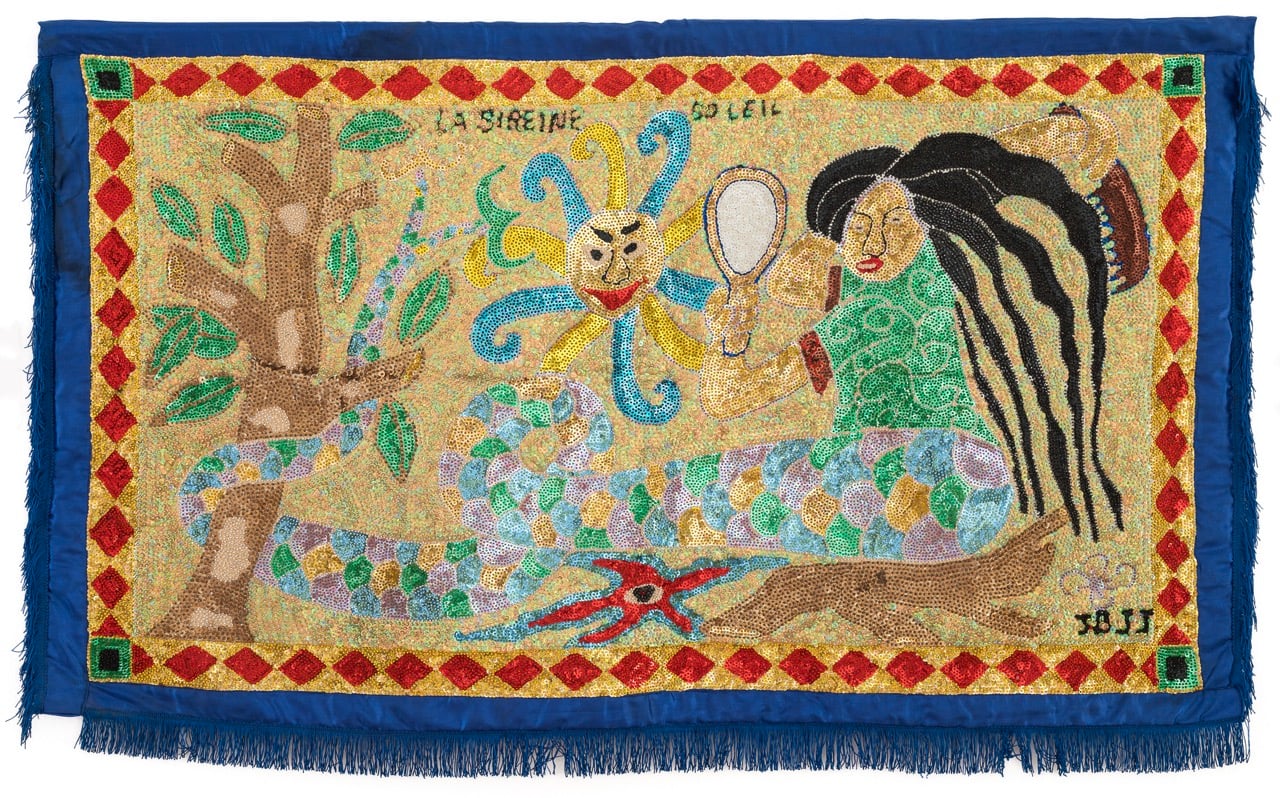
Jean-Baptiste Jean-Joseph, La Sirene Soleil, 2000, Sequins and beads on fabric,
phot. Anna Zagrodzka, courtesy of Asoto Foundation
The dela.art collection features two flags by Jean-Baptiste Jean-Joseph, an artist and Vodou priest. Jean-Joseph has been involved in craft from an early age. Before beginning his independent artistic practice, he learned basket weaving and decorative techniques and also worked in factories sewing beads and pearls onto wedding dresses.
His work La Sireine Soleil (2000), depicts Lasiren, the queen of all waters and an embodiment of feminine strength and emotion. She is accompanied by the sun and a tree, which symbolically link the elements of water, earth, and sky, highlighting the harmony of the cosmic order. The composition also features a starfish, referencing the 21 nachons (clans of the lwa spirits). The flag serves a protective and healing function, invoking the power of balance central to Vodou belief.
The flag 7 tèt (2000), depicts Erzulie Dantor, a powerful spirit of femininity and motherhood, portrayed as a mambo, a Vodou priestess. At her feet lie ritual objects—a rattle and a cauldron used in healing ceremonies. The chain encircling her symbolizes unity and solidarity, while the seven heads emerging from a single body emphasize the concept of community.
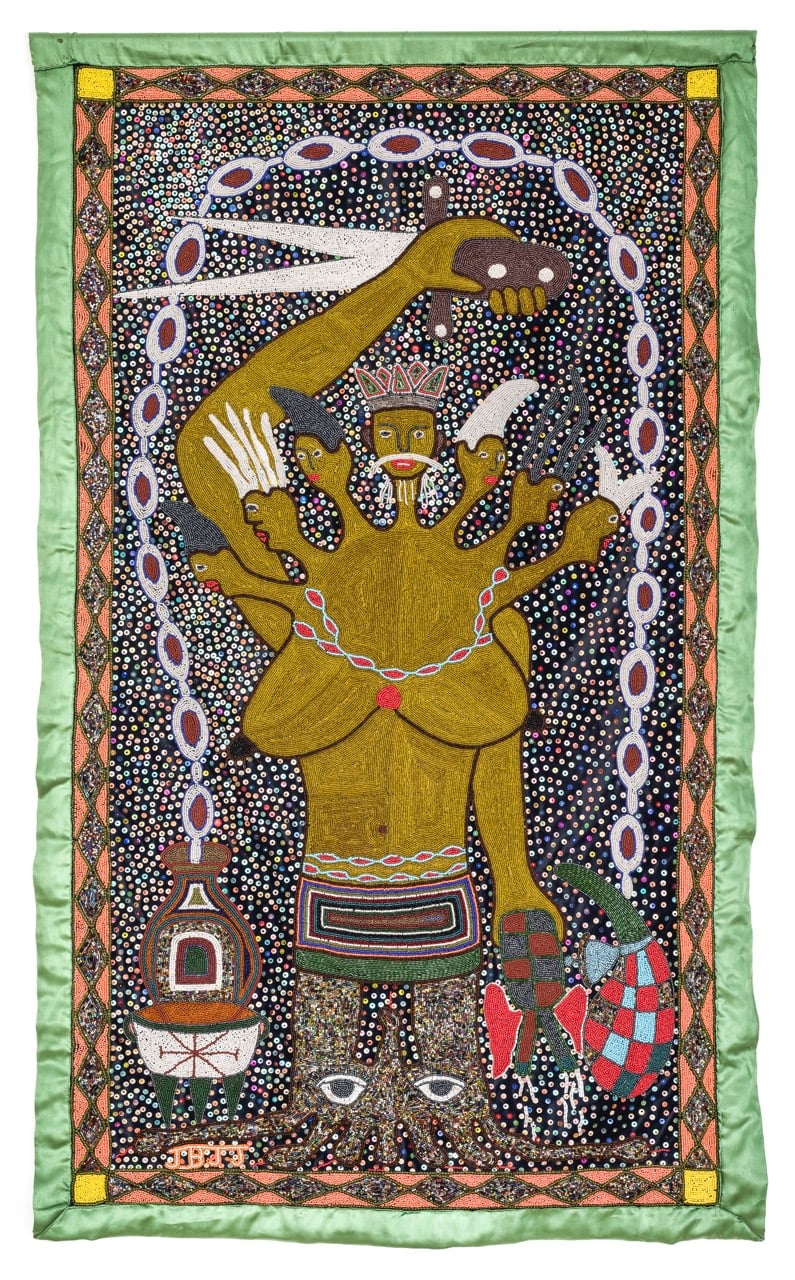
Jean-Baptiste Jean-Joseph, 7 tèt, 2000,
Sequins and beads on fabric,
phot. Anna Zagrodzka, courtesy of Asoto Foundation
Within the dela.art collection, Jean-Baptiste Jean-Joseph’s flags provide a remarkable example of art grounded in the concept of balance – the fundamental principle of Vodou, which asserts that harmony among humans, nature, and the spiritual world is the foundation of existence. Particularly significant is the motif of unity with nature. This sense of coexistence aligns with the collection’s mission, which emphasizes the inseparable bond between human beings and the natural environment and supports artistic practices that affirm this interconnectedness.
Simultaneously, Vodou exemplifies a system capable of transcending cultural and religious boundaries, creating a harmonious whole from elements that might otherwise seem incompatible. Although Vodou’s origins lie in experiences of violence and enslavement, the religion has evolved into a rich symbolic system in which spirituality, art, and nature form an indivisible unity.
Text: Anna Bykova
Maria Prokesz, Ocean of Patterns, text accompanying the exhibition at Galeria Jednostka, 2024/2025,
Mélissa Leclézio, Vodou Flags: Between the Terrestrial and the Spiritual, Culture Trip,
Nancy Josephson, Spirits in Sequins: Vodou Flags of Haiti, Schiffer Publishing, 2007.