Weronika Gęsicka,
Papilio ecclipsis from the Encyclopaedia series
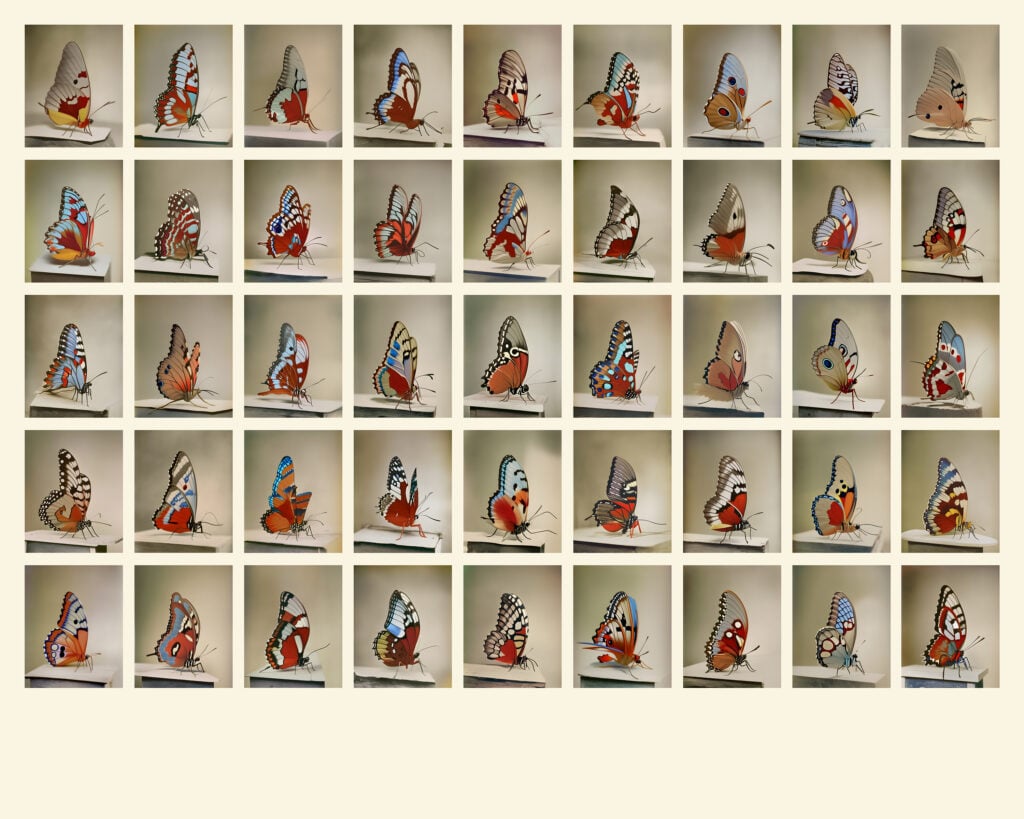
Weronika Gęsicka, Papilio ecclipsis, 2024,
from the Encyclopaedia series, AI collage,
archival pigment print, dibond, 100 x 125 cm,
phot. courtesy of the artist and Jednostka Gallery
Papilio ecclipsis from the dela.art collection, is part of the Encyclopaedia series initiated by Gęsicka in 2023, following years of research. The project is based on the concept of “false entries” – fictitious terms deliberately inserted by editors into encyclopedias, dictionaries and lexicons. This practice has existed since the early history of such publications and served as a method for detecting plagiarism. If a competing publisher reproduced the fabricated entry, it provided clear evidence of copying.
Gęsicka draws on specific examples of such entries from different periods and creates their visual representations. She constructs collages by manipulating stock photographs alongside AI-generated images, making visible what has never existed. The Encyclopaedia series comprises hundreds of fictional images. Some immediately arouse suspicion, while others are so convincing that they are difficult to distinguish from images of authentic objects. In this way, the artist demonstrates how easily the credibility of sources can be undermined.
One notable example is the story of the butterfly Papilio ecclipsis, referenced in the work from the dela.art collection. In the eighteenth century, naturalists and collectors frequently exchanged insect specimens. In 1702, the English collector William Charlton sent an unfamiliar butterfly to the naturalist James Petiver. The specimen attracted considerable attention and was described by Carl Linnaeus as a new species in his work Centuria Insectorum Rariorum. The butterfly closely resembled the species named Common Brimstone, but differed by several dark spots on its wings. It was not until 1793 that it was discovered these spots had simply been painted on, revealing that the supposed new species was, in fact, entirely ordinary. The case caused a stir among entomologists. To this day, the true origin of this peculiar specimen remains uncertain: was it a collector’s joke taken too seriously, or an attempt at mystification aimed at gaining scientific recognition? For a long time, however, Papilio ecclipsis continued to appear in scientific literature and encyclopedias as a distinct species. Today, it survives primarily as a curiosity in the history of entomology.
Gęsicka’s work evokes this story while situating it within a broader context. Visually, it resembles illustrations from historical natural history atlases, referencing the tradition of scientific representations of nature. However, it simultaneously calls their reliability into question. In the eighteenth century, a careful observer could still recognize that the spots on a butterfly’s wings had been painted by hand. In a world shaped by AI-generated imagery, such certainty is no longer self-evident. It becomes difficult to determine which of the butterflies depicted in Gęsicka’s work are real, which have been altered, and which are entirely fictional – or whether any of them exist at all. The artist suggests that while the manipulation of knowledge is not a new phenomenon, the tools enabling it are becoming increasingly sophisticated.
Charlotte Cotton, Encyclopaedia, in: Weronika Gęsicka, Encyclopaedia, BLOW UP PRESS, Galeria Jednostka, 2024
Michał Dąbrowski, “Weronika Gęsicka, Encyclopaedia”
Ania Diduch, “The Truth and Fiction of Encyclopaedias,” Fotofestiwal 2024