Sougwen Chung,
Object 3
I’m driven by curiosity – not cutting-edge for its own sake but the realization that new technologies have broad applications and implications in culture, including how we experience and see ourselves and the world around us.
Sougwen Chung
Sougwen Chung is a Chinese Canadian artist and researcher, widely regarded as a pioneer in the field of human-machine collaboration, exploring the distinctions between marks made by hand and those created by machines.
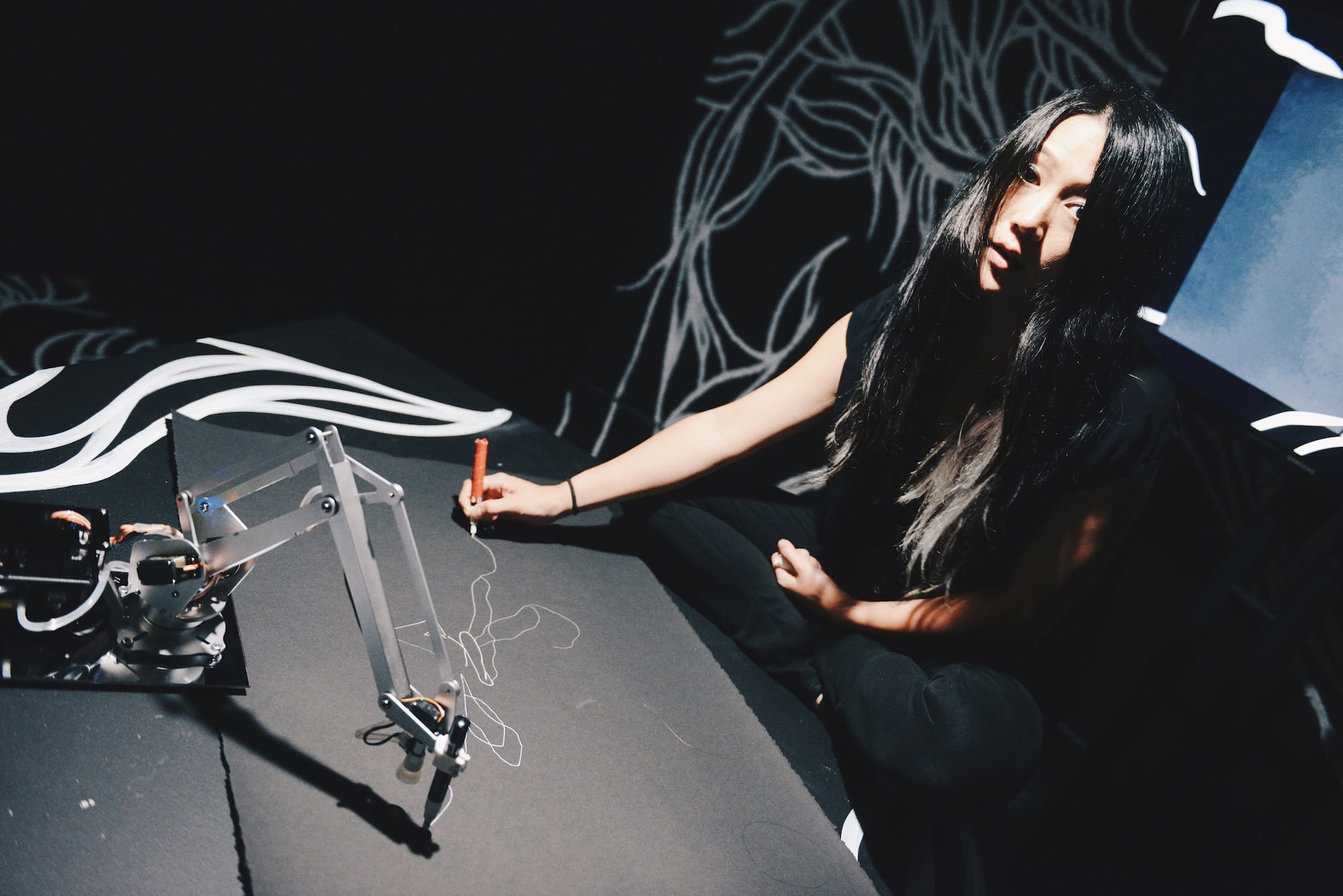
During their time at MIT, Chung developed and constructed robots that they named D.O.U.G. (Drawing Operations Unit Generation_X). These robotic systems are designed to replicate the hand-drawn movements of the artist, working in harmony with them to create synchronized artworks. The robots operate within a dynamic feedback loop, interacting with Chung to produce sketches informed by neural networks determined by the artist’s unique drawing gestures and biometric data.
Chung approaches AI not as a tool for achieving predefined goals but as a space for exploring potential. Their creations delve into the ways we navigate relationships between humans, machines, and other non-human entities.
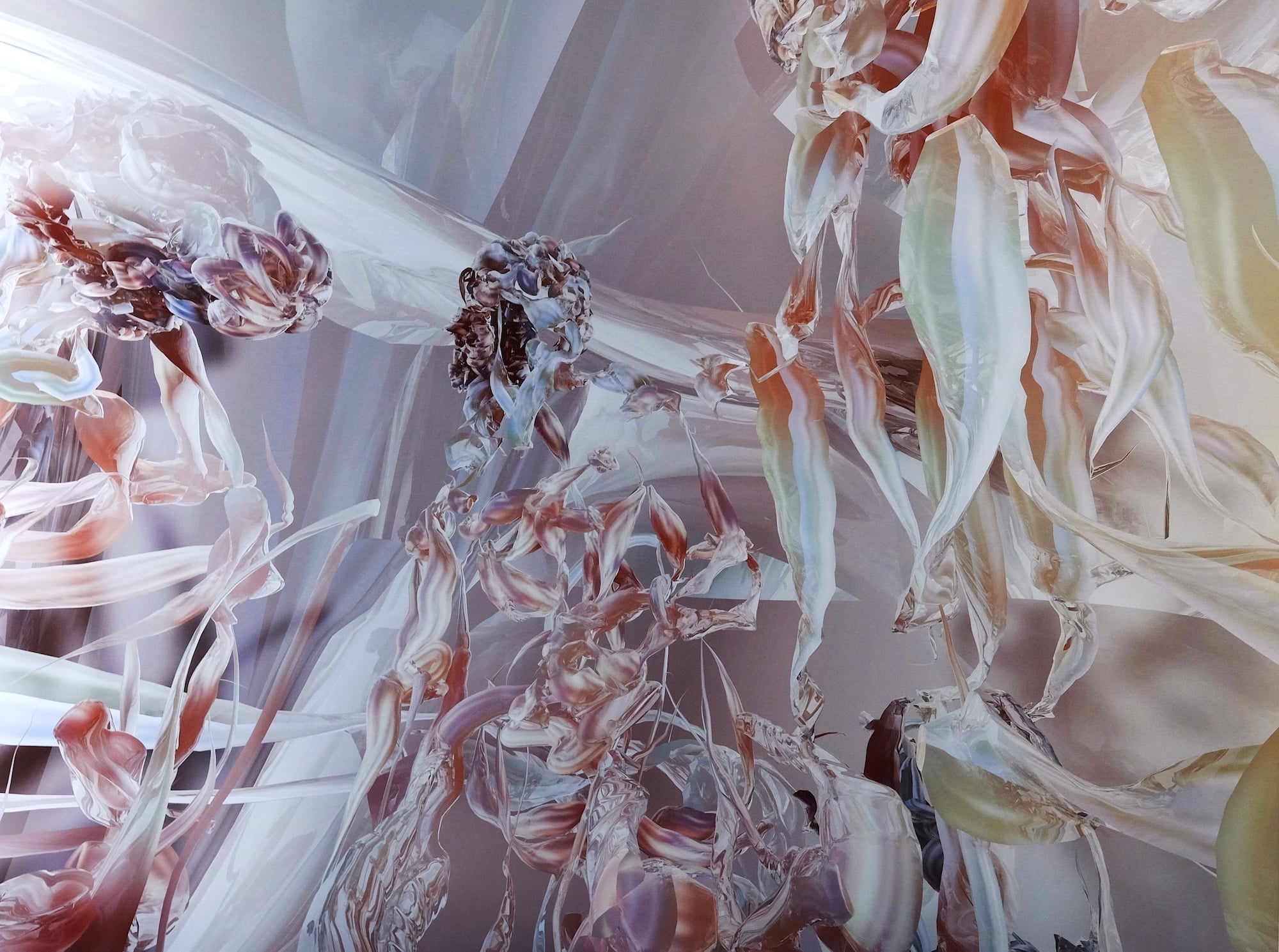
The title of the series “Hylomorphism II” refers to a philosophical concept. According to the theory of hylomorphism, every being consists of constant primary matter and variable substantial form. This premise elucidates phenomena such as the transformation of one substance into another and more broadly, any kind of transformation of biological matter. In simpler terms, hylomorphism is a fundamental characteristic of nature, where elements exist, change, and perish, giving rise to new forms of life through a complex network of natural interdependencies. Sougwen Chung’s abstract artwork features biomorphic shapes that evoke the forms of plants. The floral motif connects to the concept of hylomorphism, which refers to the ability of “natural bodies” to undergo the organic transformation of matter.
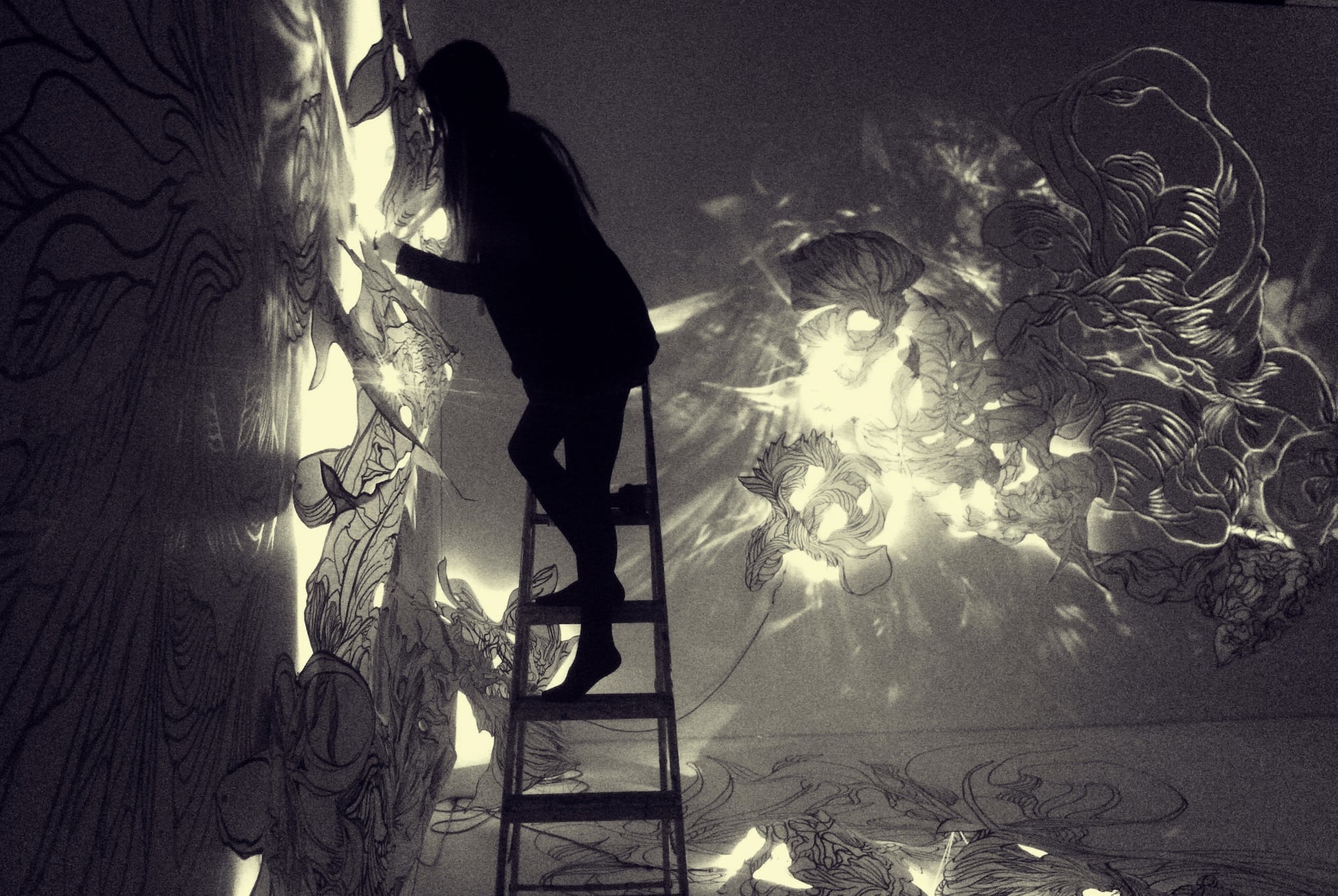
Sougwen Chung’s works seamlessly merge the realms of science and art. While this fusion serves as the foundation of their innovation, it is essential to recognize that it is not merely a hallmark of contemporary times. The integration of science and art has deep historical roots: in antiquity, when the pursuit of absolute beauty was grounded in the mathematical principles of the golden ratio; during the Renaissance, which examined human nature through the lens of scientific inquiry and the Vitruvian ideals of harmony between biology and geometry; in the Enlightenment, where discoveries in the natural sciences inspired painting, and illustrated encyclopedias, anatomical atlases, and maps combined scientific knowledge with aesthetic expression; and in the futuristic experiments propelled by technological advancements.
Today, the widespread digitization, robotics, and accessibility of artificial intelligence tools open up new possibilities for artistic exploration. The democratization of artistic forms, along with the growing freedom artists have in choosing their mediums, results in extraordinary and innovative works that increasingly blur the boundaries between disciplines.
Sougwen Chung’s work exemplifies one of the core values of the dela.art collection: breaking barriers and pursuing unconventional artistic solutions. Furthermore, the piece embodies a holistic and unifying perspective that is central to the collection, merging the organic nature of spontaneous human creativity with precise calculations, engineering, and artificial intelligence.
Text: Anna Bykova