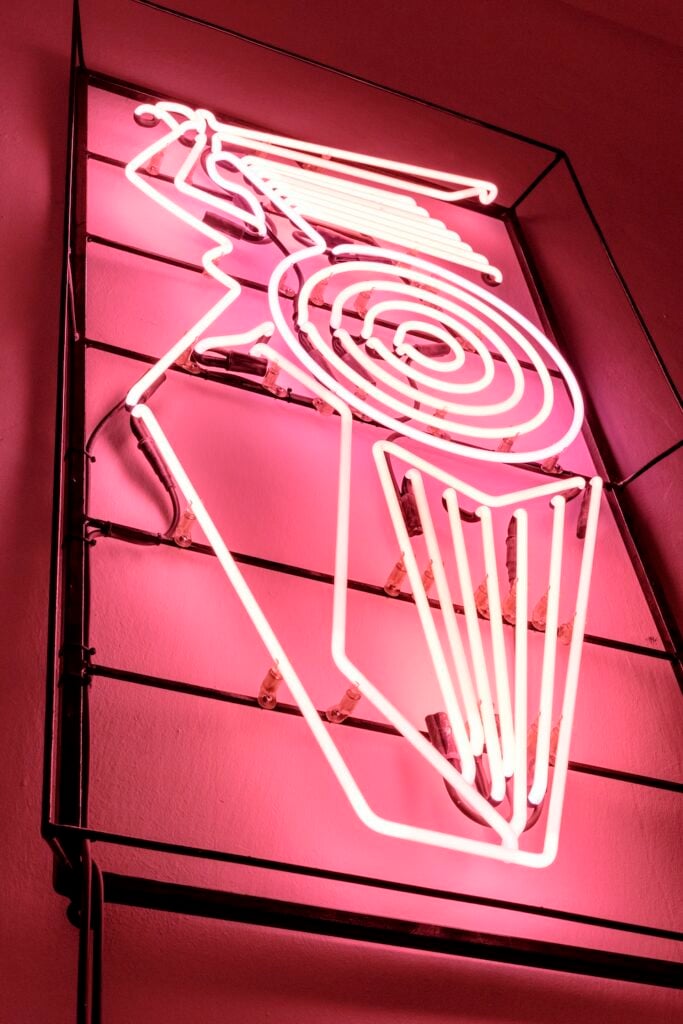
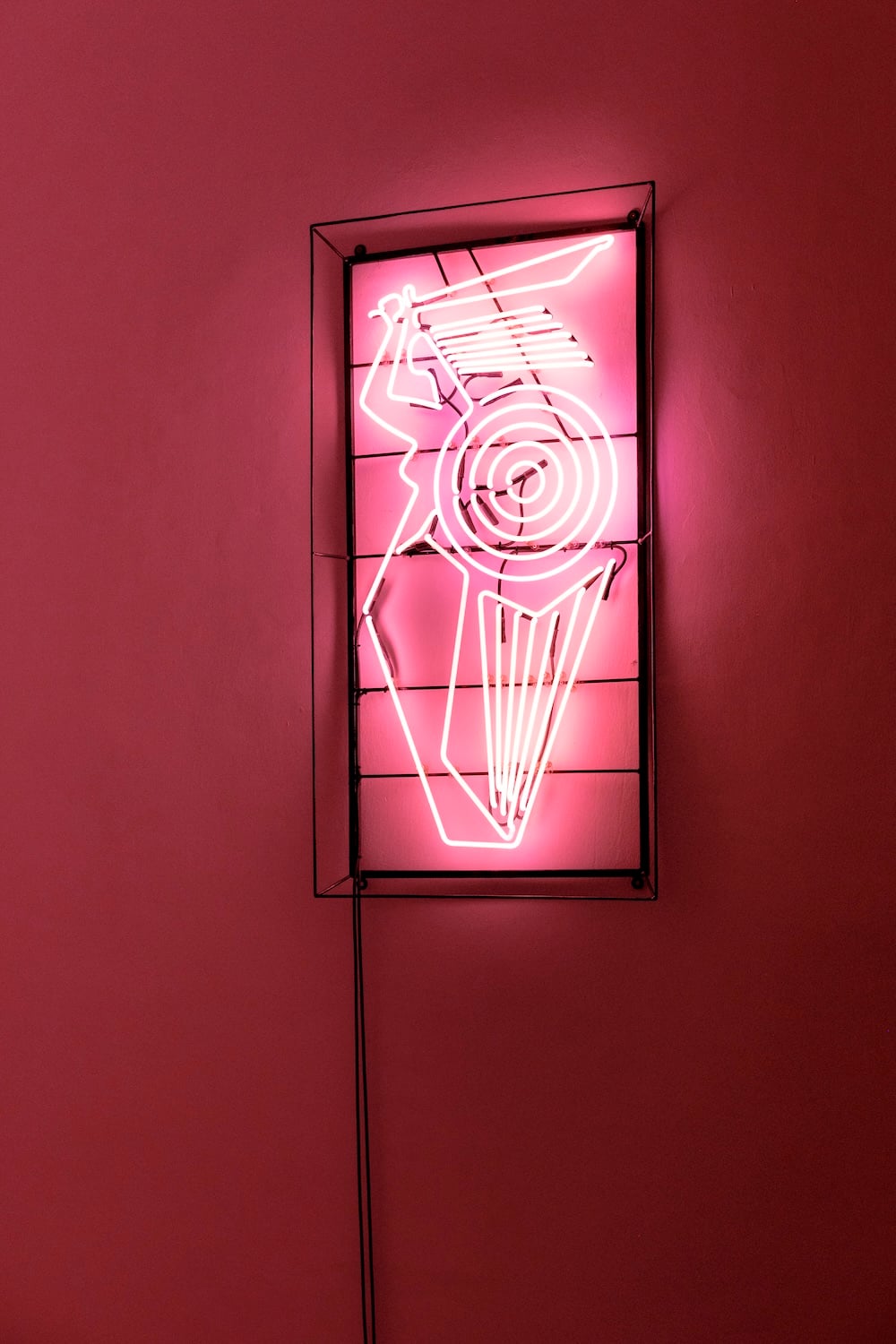
The neon Mermaid by Maurycy Gomulicki from the dela.art collection is illuminating Koszyki! Presented at the heart of Hala Koszyki in Warsaw, it brings contemporary art closer to a wider audience, becoming part of the city’s dynamic rhythm.
The project was carried out in collaboration with Eneris and Hala Koszyki.
Maurycy Gomulicki, Mermaid, 2015-2017, neon, 129 x 11 x 68 cm, phot. Bartosz Górka, courtesy of Leto Gallery
Maurycy Gomulicki’s work largely centers on affirmation. His focus on the phenomenality and beauty of ubiquitous elements in our fundamentally tragic lives is a deliberate and conscious choice, reflecting a purposeful stance. Popular culture serves as a significant source of inspiration for the artist. He is drawn to what appears trivial or banal, yet in these platitudes he also perceives lushness, vitality, strength, and grace.
Gomulicki’s pink mermaid operates at the intersection of several themes and thus warrants consideration within a variety of contexts. On the one hand, it evokes the lightness of modernist visual language – the immediate inspiration for its creation was the decoration of a porcelain platter made in 1968 by Jan Ciaś, originally designed by Hanna Modrzewska-Nowosielska. On the other hand, it references a particular phenomenon: neon signs, which were initially conceived purely as advertising devices but quickly became a defining element of the capital’s nocturnal landscape. These harbingers of modernity unexpectedly acquired a distinctly lyrical dimension.
The first neon signs appeared in the capital as early as the 1920s, becoming one of the elements that helped shape Warsaw’s image as a modern city. After the war, they played a particularly important role in the city’s reconstruction, emerging as symbols of returning life and urban energy.
In the late 1950s, a plan for so-called “neonisation” was announced, envisioning the illumination of the city with color. Gomulicki refers to this period as an “electric spring.” His work engages in a dialogue with this tradition. Against this backdrop, its personal dimension also becomes clearly evident. An exceptionally important figure in Maurycy’s life was his grandfather, the eminent Varsavianist Juliusz Wiktor Gomulicki, who took his place after Maurycy’s father’s premature death – naturally embedding a love of Warsaw into the artist’s universe as one of its key components.
Maurycy Gomulicki, Mermaid, 2015-2017, neon, 129 x 11 x 68 cm, phot. Bartosz Górka, courtesy of Leto Gallery
The mermaid motif recurs repeatedly in Gomulicki’s work. It serves as a direct reference to the symbol of the capital; but it also reflects his broader interests in femininity, sensuality and their archetypes. The tailed girl from the dela.art collection has a sister – a cobalt neon mermaid by Gomulicki displayed in the foyer of The Syrena Cinema at the Muzeum of Warsaw. Both works can be seen as elements of a larger, nostalgic narrative about the city. It is also worth recalling other electric mermaids from Warsaw’s streets – from the mermaid of Warszawski Kurier Telewizyjny to the emblem of the capital’s public libraries: a neon mermaid seated on an open book, now exhibited at the Neon Muzeum.
Color remains one of the key elements in Gomulicki’s art. For the artist, it is not merely an aesthetic category but, above all, a vehicle for emotion and energy. Gomulicki explores the social dynamics of color and challenges the divisions between “good” and “bad” taste, embracing vivid, fluorescent hues often dismissed as garish or kitschy, yet understood by him as uniquely suited to expressing admiration for vitality and the joy of existence. Within this palette, pink occupies a special place – associated with sweetness, it evokes afterimages of happiness and pleasure, forming an ideal counterpoint to the greyness that saturates our hearts with melancholy.
The Mermaid is on view on the ground floor of Hala Koszyki at 63 Koszykowa Street in Warsaw.
We use cookies to ensure that we give you the best experience on our website. If you continue to use this site we will assume that you are happy with it.