The Circle – A Symbol of the Ideal
The circle, one of the simplest and most harmonious geometric shapes, has fascinated humankind for centuries. Present across numerous cultures, religions and philosophical traditions, it serves as a means of ordering reality while symbolizing transcendence and spiritual balance.
In ancient cultures, the circle was an important symbol associated with beliefs and rituals. For the Indigenous peoples of North America, the sacred hoop represented spiritual balance and a profound connection with nature. In ancient Egyptian and Greek cultures, a similar role was played by the ouroboros – a serpent devouring its own tail – symbolizing eternity and the endless cycle of transformation. Ancient civilizations of the Middle East, in turn, used the circle to represent solar deities. Among the ancient Slavs, the circle was likewise associated with the sun, the rhythms of nature, the changing seasons and the renewal of life. Traces of these beliefs can still be found in ritual circle dances, the tradition of forming protective circles against dark forces and round ceremonial breads.
The circle also plays a fundamental role in religious systems worldwide. In Hinduism and Buddhism, it appears as the mandala – a sacred diagram representing the cosmos and the spiritual path toward enlightenment. In Christianity, the halos surrounding saints and the circular rose windows of Gothic cathedrals symbolize divine perfection and infinity. In Islam, geometric arabesques and the domes of mosques emphasize the harmony of the divine order.
Mandala – The Ultimate Archetype
In its simplest form, a mandala is a circular pattern, often symmetrical and intricate, composed of numerous details. Its meaning and function vary depending on the cultural context, yet it consistently embodies the concepts of unity, harmony and spiritual integration. In Buddhist and Hindu traditions, the mandala plays a fundamental role in spiritual practice. The word “mandala” itself comes from Sanskrit and means “circle” or “center.” It is understood as a microcosm – a symbol of the universe and the spiritual path toward enlightenment – and also serves as a meditative tool, helping to focus the mind and attain transcendence.
The mandala entered Western culture primarily through the work of Carl Gustav Jung, who recognized it as a universal symbol of psychic wholeness, a representation of the unconscious and an archetype of the Self. According to Jung, the mandala served an integrative function: it provided a structure for organizing inner chaos and guiding the individual toward harmony. Jung emphasized that the circular form is deeply rooted in humanity’s collective memory, recurring across different periods and cultures as a symbol of divine wholeness, the unity of opposites and self-knowledge.
Mandalas in the dela.art collection
The dela.art collection comprises a series of works dedicated to reinterpreting the mandala motif, embodying a holistic worldview and a quest for harmony and unity in our relationship with the environment. While the collection includes classical representations of the mandala, it also features works that explore the circular form more broadly. The circle appears in abstract compositions, cosmic visions and works symbolizing the flow of energy, the renewal of resources, and the cyclical rhythms of nature. Additionally, some works critically address the challenges of the contemporary world.
The circular works of Xawery Wolski are distinguished by their metaphysical depth. The artist uses terracotta, an organic material, to emphasize the primordial connection between his sculptures and nature. Wolski’s pieces are composed of small, precisely formed elements that come together to create harmonious, concentric compositions.
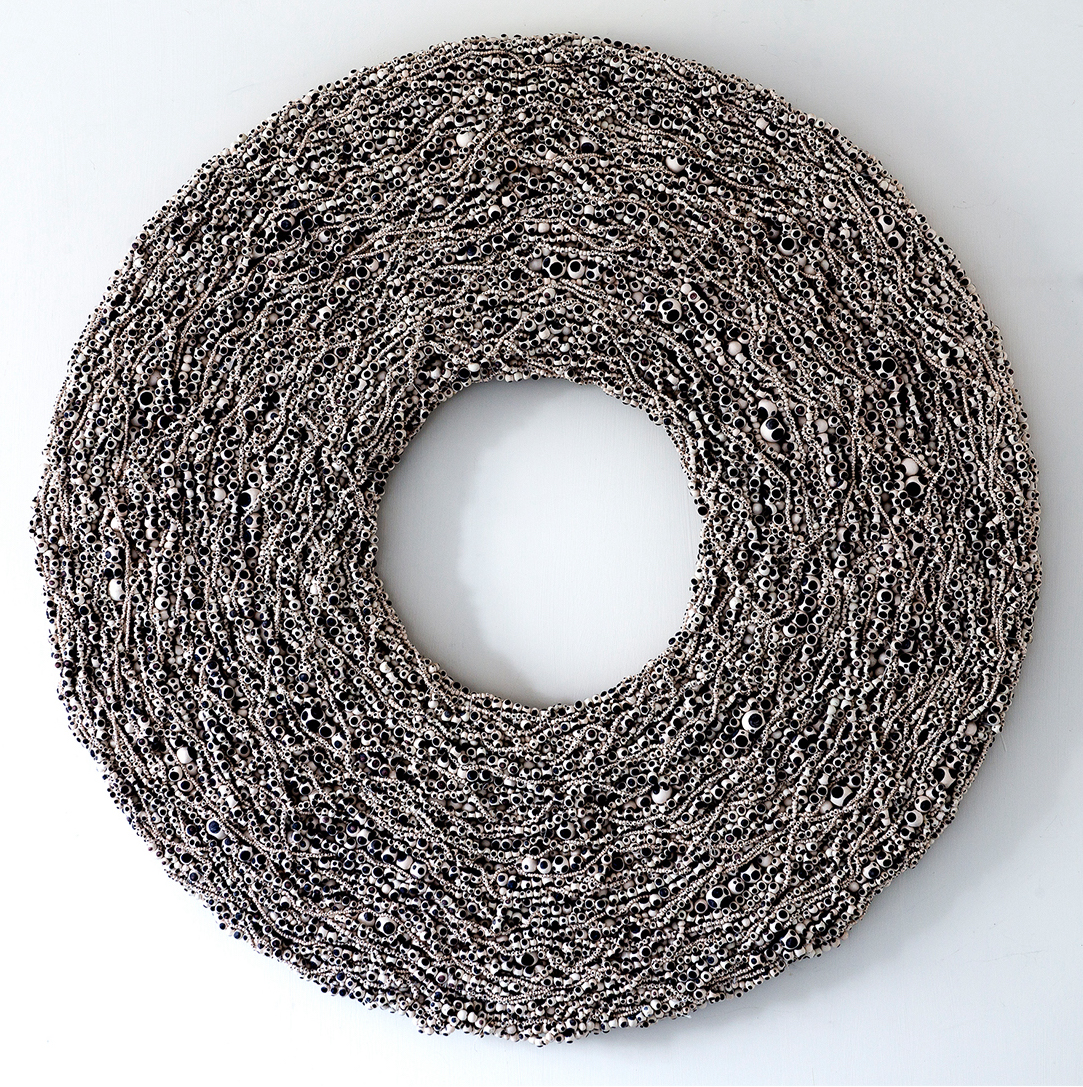


Xawery Wolski, Black-and-white Circle, 2010, polychrome terracotta
Xawery Wolski, Platinum Mandala, 2010, terracotta, platinum enamel, wood
Xawery Wolski, Golden Mandala I, 2013, terracotta covered with 24k gold enamel, wood
Włodzimierz Jan Zakrzewski’s Zero, combines painting with a sound installation. The visual element is accompanied by a composition by American composer Julius Eastman: a four-minute excerpt for four pianos played simultaneously backwards and forwards across four channels. This technique renders the duration of the composition theoretically equal to zero, symbolically emphasizing circular repetition through a relationship of opposites – sound and silence, black and white, plus and minus.
In the work of Irena Nawrot, the mandala takes on a floral form, with the rose – a flower rich in symbolism – occupying a particularly important place. The rose is part of a series devoted to life and death, presenting them as integral elements of the natural order of the world. Through the circular form of the mandala, Nawrot clearly emphasizes the cyclical nature of existence, while the flowers composing the work evoke Buddhist mandalas.


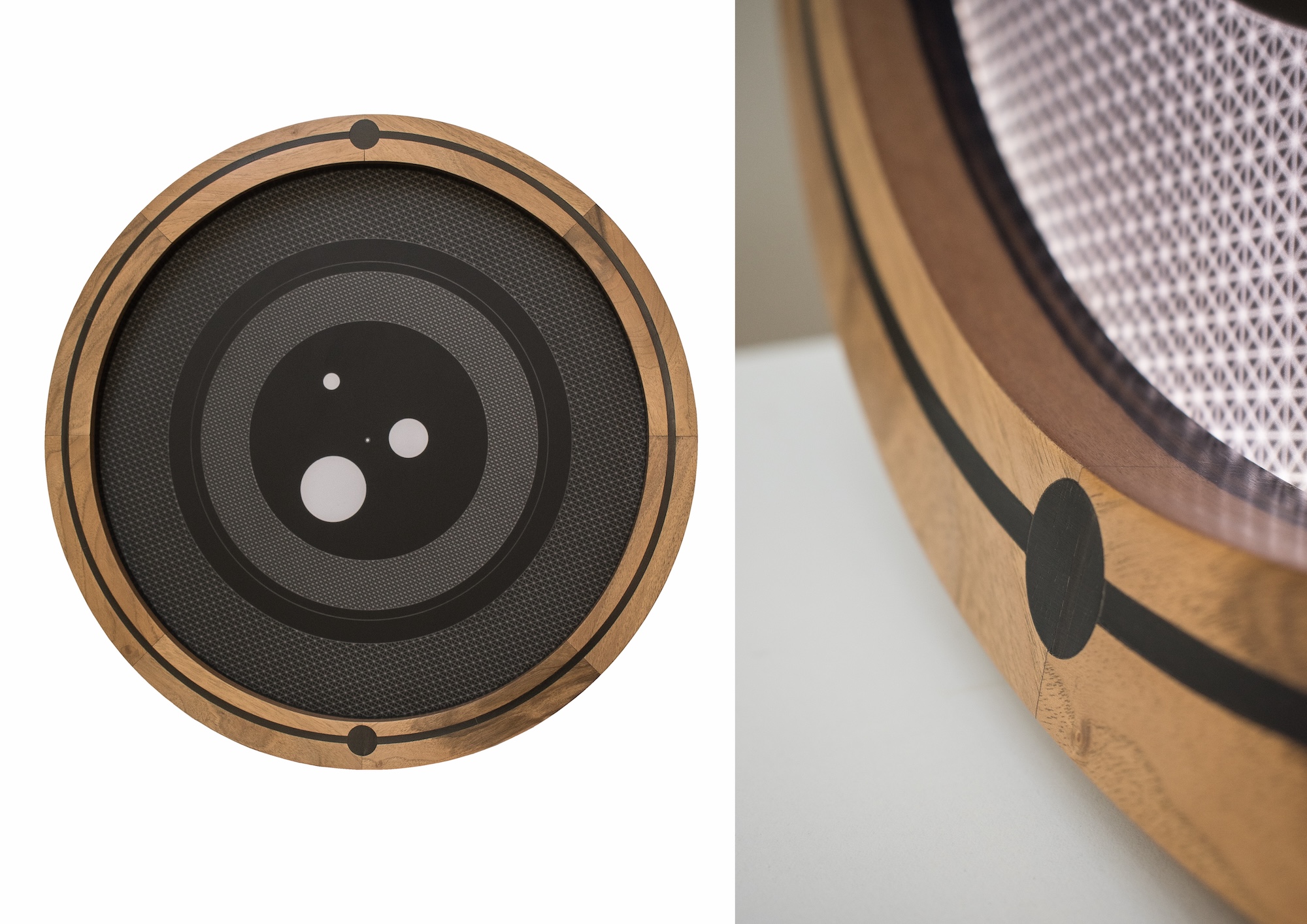
Krzysztof Sokolovski creates neo-sacred art that draws on traditional circular forms of religious iconography while simultaneously introducing associations with planetary systems. Subtle Being functions like a cosmic lens, transforming the experience of awe at the infinity of the universe into a metaphysical encounter with the sacred. In this way, the artist intertwines spiritual motifs with a fascination for the cosmos, highlighting their shared contemplative origins.
The work I Am Pregnant by the duo Kijewski/Kocur, composed of walnuts arranged in a circular form, reflects the artists’ characteristic blending of elements associated with both high and low culture. Walnuts, whose hard shells conceal soft interiors, symbolize the biological duality of protection and vulnerability inherent in pregnancy. This meaning is further reinforced by the circular form, which in many cultures is linked to the feminine principle and fertility cults. In this way, the artists unite themes of creation, transformation, and the interpenetration of the sacred and the profane in contemporary culture.
Kamil Sipowicz creates his Transmandalas as a contemporary reinterpretation of the Tibetan meditative practice, transforming this traditional form of contemplation into an ironic reflection on the darker aspects of popular culture. The artist recycles images sourced from the internet that, rather than leading to spiritual liberation, evoke feelings of unease and anxiety. Celebrities replace ancient gods, while the harmonious order of nature gives way to chaos and the idolatry of mass culture which prioritizes instant gratification over the time-consuming pursuit of spiritual fulfillment.
In Money Makes the World Go Round XX, Carlos Aires presents a critical reflection on contemporary symbols of power. Using banknotes from some of the world’s wealthiest countries, the artist cuts out silhouettes of figures, events, and symbols, highlighting the hidden relationship between money and global crises. In this context, the circle no longer functions as a symbol of harmony or spiritual balance; instead, it becomes a metaphor for inevitability and the cyclical repetition of mistakes from which contemporary society appears unable to break free.
Contemporary reinterpretations of the mandala, while drawing on the traditional symbolism of the circle, reveal an exceptionally broad spectrum of meanings and contexts. This diversity of interpretations demonstrates that the mandala is not a fixed formal scheme but rather a universal medium through which artists reflect on the world and humanity’s place within its structure.


Kijewski/Kocur, I’m pregnant, 1993, walnuts, plywood, rubber
Kamil Sipowicz, Transmandala VII, collage, pigment print on archival paper, foam board
Carlos Aires, Money Makes The World Go Round XX, 2024, original banknotes, cardboard, goldenpins, foam, courtesy of the Molnár Ani Galéria